
Out of line
Bad behavior, social norms, and the LA mayor's race

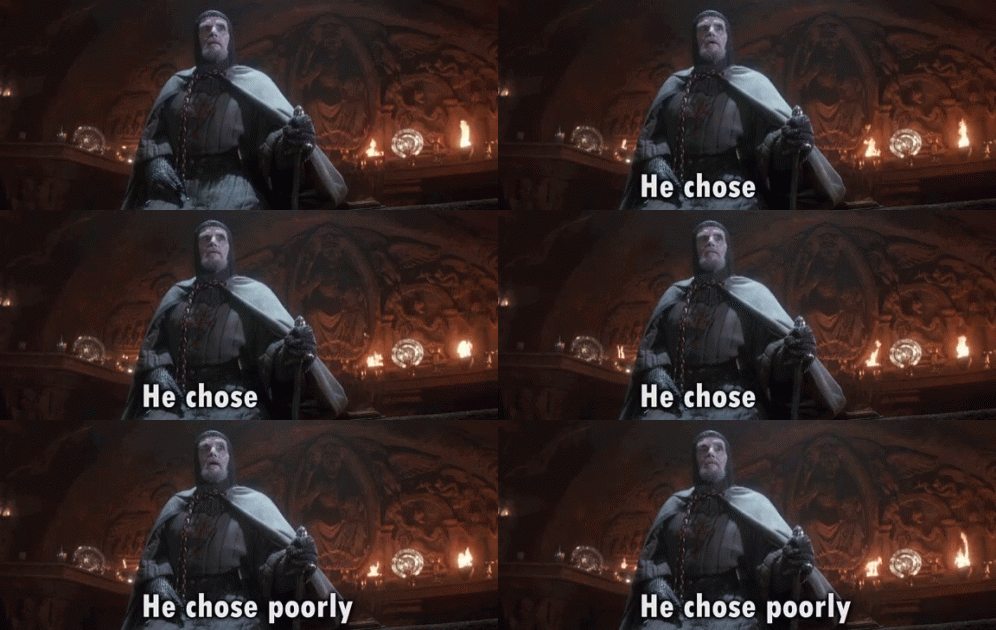
If there are two lines, I usually pick the slower one. Chalk it up to bad judgement. Like Walter Donovan, the Nazi-curious antiquities collector from Indian Jones and the Last Crusade — my brand is poor choices.
Last weekend provided another entry in my long catalogue of poor choices when it comes to lines. As we were leaving a parking lot, I picked the shorter line because it appeared … shorter. It wasn’t. The problem? The woman ahead of me couldn’t figure out how pay. The machine accepted her ticket no problem, but her credit card was a different story.
She put the card in one slot, then another, then waved it around the machine like an intoxicated symphony conductor. This went on for three minutes, but it felt like three trillion years. At one point, Christina asked if she should get out and help the lady. But as soon as Christina unbuckled her seatbelt, the rear door on the driver’s side opened. A man poked his head out and puked. Suddenly, as if by magic, the gate opened. The woman pulled forward, banging the open door against the payment machine, which caused the door to swing shut, knocking her nauseous passenger on the head. After clearing the gate, the woman made a left turn, despite a sign that said, “right turn only.” I shook my head, held my breath, and rolled forward to pay. The process took thirty seconds, but it felt like thirty trillion years because time stands still when you’re enduring the fetid funk of a stranger’s puke.
At the pharmacy, a few days later, I thought I’d lucked out because there was only one line. No choice, no problem. But as soon as it was my turn, an old lady cut in front of me to ask the pharmacist a question.
“I’m sorry, ma’am, but there’s a line, and that gentleman was here first.”
I waved to let her know I was the gentleman in question.
“I’m an old woman,” she said, before turning to the pharmacist to ask if they carried toe spacers. They didn’t, so the old woman asked another question, then another, and another.
Eventually, it was my turn. I was there to pick up some medication, but now I had a question.
“Is it true that if you’re old enough you don’t have to wait in line?” I asked.
“No, she was out of line.”
“She was never in line.”
“I’m sorry about that,” the pharmacist said.
“Don’t be. It’s not your fault she’s spent all this time on Earth without learning how lines work.”

Not that a person’s age is a determining factor in their ability to master the line concept. Some situation normies may recall a recent encounter with a teenage line-cutter while I waited for a beverage. As far as I know, that teenage scofflaw remains at large.
Sometimes I wonder who invented the line. I always imagined that early humans created the line when someone made a cave painting that was so good everyone lined up to see it, because not everyone could fit inside the cave at the same time. But according to David Andrews, author of Why Does the Other Line Always Move Faster?, my theory is several thousand years ahead of schedule. In his book, Andrews traces the line — see what I did there? — to the French Revolution, or rather, to Thomas Carlyle’s history of the French Revolution. As Andrews explained to the Associated Press, Carlyle, a Victorian-era historian, satirist, and social commentator, wrote about queues — literally in old French “tails” — at bakeries in 18th century Paris. In his history of the French Revolution, Carlyle wrote, “Patriotism stands in queue.” As Andrews explained, “The slogan of the French Revolution was ‘Liberty, Equality, Fraternity’ … [to] patiently wait one’s turn was to hold everyone as equals.” According to Andrews, the line occupies a similar place in American society. “We believe that all are created equal. So, too, do we stand in line.”
That sounds nice in theory. In practice, however, the belief in equality is far from universal. Line-cutters, bigots, sexists, celebrities, assholes, and narcissists are just a few of the groups that believe they’re better than other people. For them, a line isn’t a social norm that reinforces equality, it’s an opportunity to set themselves apart from, and above, the rest of us. That line you’re standing in, their logic goes, is for suckers.
Many of us believe that if enough people refuse to participate in norms like lines, we’ll devolve into a state of anarchy. This is incorrect. Anarchy is fleeting. Sooner or later, but usually sooner, a strong person, usually a man, emerges to impose order. In theory, that strong person could say something like, “Hey, dingleberries, let’s act like adults and form a motherfucking line.” In practice, however, it usually comes out like, “me first, the people I like are next, and everyone else can eat a bag dicks.” This is the problem with what political scientists call “the rule of man.” It’s capricious and cruel. At the other end of the order spectrum, where lines and other niceties are considered norms, is the rule of law. It’s a slow, clunky mechanism for governing, but as Walter Sobchak said about bowling, “there are rules here.”
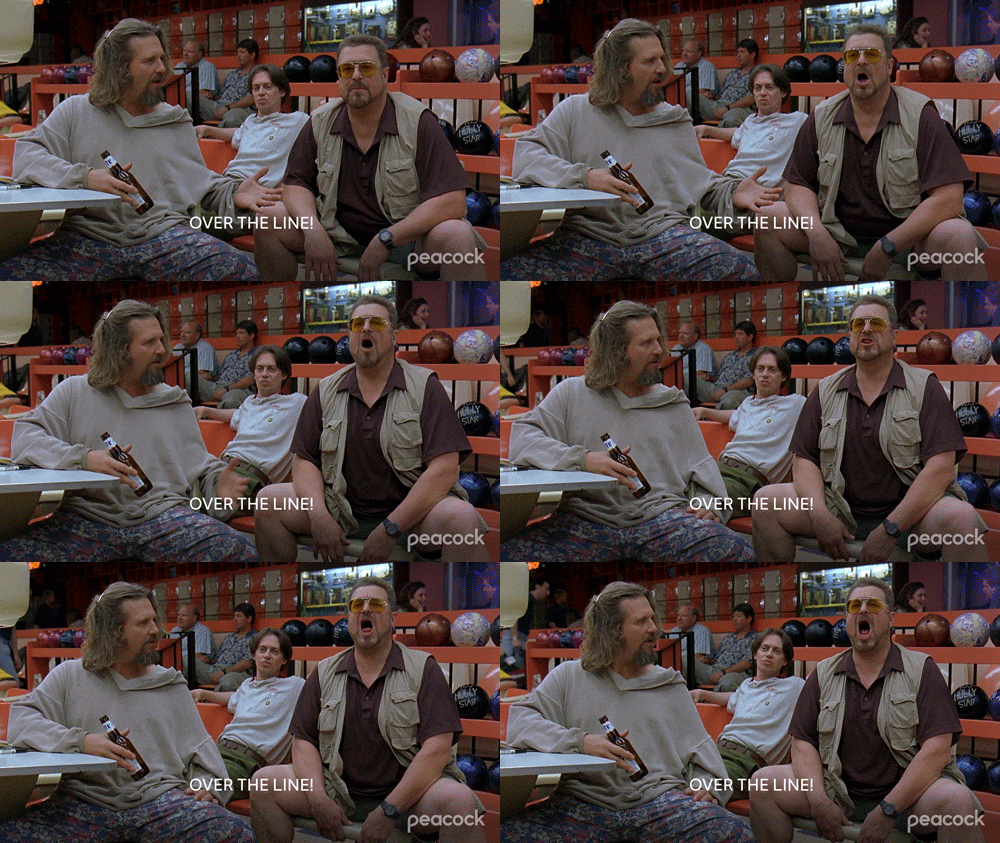
The salient feature of a society based on rules is that everyone is slightly more miserable for having to follow those rules, but significantly safer, more prosperous, and less stressed because everyone else follows the rules too. In the abstract, it’s a great trade — better than the deal the Yankees made to acquire Babe Ruth from the Boston Red Sox. But when you’re standing in line you can’t help but feel cheated somehow.
Which brings me to the election, specifically the Los Angeles mayor’s race. On the one hand, there’s a group of mediocre candidates with differing ideas about how to fix a great, but somewhat broken, city. One thing they have in common, I think, is a belief in lines. True, some of them have shitty ideas about how to organize a line, and all of them lack the charisma to make lines sound like a good idea. But they are line-people, and the thing about line-people is that you can work with them. You do it every time you stand in line together. On the other hand, we have Spencer Pratt. He’s not a line-guy. Frankly, that’s the nicest thing I can say about him. Actually, I’ll say one other nice thing about Spencer Pratt. I find his decision to spend all of his money in 2012 because he believed the Mayan apocalypse was real to be intellectually honest and comedically rich. But the Mayan apocalypse is neither here nor there.
The important thing, at least as far as the mayor’s race goes, is that Pratt isn’t a line-guy. Deep down, or maybe right at the shallow surface, I think Pratt’s supporters know this. They see a malfunctioning line called Los Angeles, and they want someone to fix it. That’s a reasonable request, even in unreasonable times. The trouble is, the line-people in the race just aren’t credible line-stewards. The only credible candidate in the race is Spencer Pratt, not because he’s telling the truth, but because everybody knows he’ll smash the line, which sounds preferable if you believe the line is beyond repair.
And that’s the crux of the choice we face: a broke-dick line that many believe is hopeless, or no line at all. As I wrote at the beginning of this post, making poor choices is on brand for me. Maybe lines no longer work. Maybe we’re post-line. Maybe we want anarchy and are willing to accept the rule of man that fills whatever vacuum anarchy creates. I honestly don’t know. But I intend to hold the line.
Need a book to read while waiting in line?
I got you.
Not Safe for Work is available at Amazon and all the other book places. Murder and Other Distractions is available here. And Ride/ Share can be purchased here.
My books won’t save the world, but they’ll make you laugh while everything goes to hell. Promise.
I’ve got questions, maybe you have answers!
Will you hold the line or smash it? Choose wisely
How old do you have to be to cut in line? Wrong answers only.
Who invented the line? Go deep!
Why did the parking garage gate suddenly open? Was it the puke? Divine intervention? Gremlins? Give us your best theory!
How stupid did Spencer Pratt feel after the Mayan apocalypse came and went without ending the world? Show no mercy.
It’s possible some smart person might come along and suggest that some Ancient Greek fellow invented the line, but if I’ve learned anything over the years, both on the internet and from American movies (ideally summer blockbusters, but any American-made movie will do as we can’t always get what we want … and yes, that’s a reference to the great American band, The Rolling Stones) is that an American invented the line. Here, then, are my proofs:
- The foul lines … Abner Doubleday famously separated fair and foul territory with the foul lines when he didn’t invent baseball in Cooperstown NY in 1839.
- The offensive line … Walter Camp in 1880 … and he was immediately flagged for a false start
- The free throw line … invented by Dr. James Naismith … the paying lines, alas were invented outside the arena. The nosebleeds were invented soon thereafter.
- The blue line … Ha! Trick question! The blue line magically willed itself into existence sometime around the latter stages of The Great War (won by the Americans!). However, should Canada become America’s fifty-first state, there may be some retroactive acknowledgment that Frank Patrick (a reasonably American-sounding name) might have had something to do with it.
- Funky bass lines … James Jamerson and Larry Graham.
The problem with the egalitarian theory of lines? We have socially-approved methods of line-jumping, like Disneyland’s Fast Passes. You’re sending a socially-approved message that only poor schmucks stand in line and think young people won’t notice?